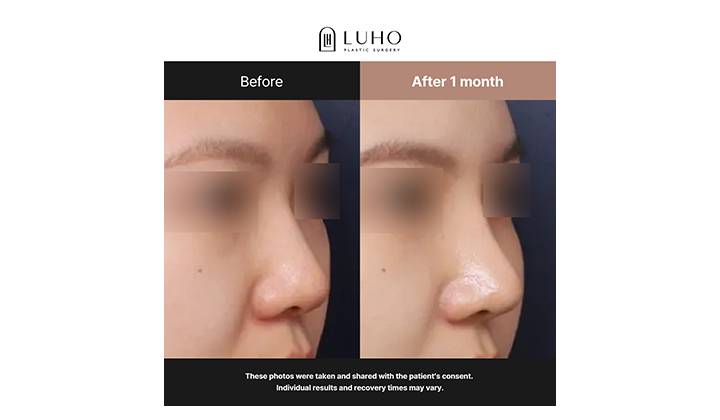
Many people considering rhinoplasty
wonder about the differences
between open and closed techniques,
and which method is more suitable for them.
Although these procedures may seem
to differ only in incision location,
they actually vary in purpose, surgical approach,
and scope of correction.
Rather than deciding which method is 'better,'
the more important factor is choosing
the approach that best fits
your individual nasal structure and aesthetic goals.
"Open Rhinoplasty"
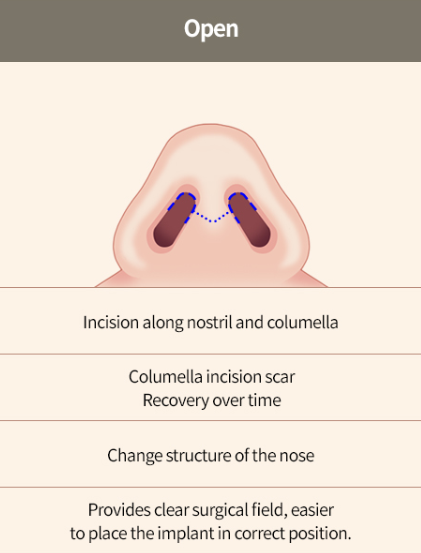
Open rhinoplasty involves an incision
made on the columella (the skin between the nostrils),
allowing direct visualization of the internal nasal structures.
This approach provides excellent visibility,
enabling precise implant placement
and highly detailed shaping and correction.
It allows structural access to:
• Nasal tip cartilage
• Septal cartilage
• Overall nasal framework
However, open rhinoplasty does result in
a small incision scar on the columella
and typically involves a longer recovery period.
"When Open Rhinoplasty
May Be Recommended"
*For detailed nasal tip shaping
• Nasal tip extension
• Bulbous, low, or twisted nasal tip
• Weak nasal tip support (septum) or collapse
When septal issues need correction
*Deviated septum
• Need for septal cartilage harvest
• Structural issues causing nasal obstruction
For upturned or short nose correction
• Short nasal tip or upward-rotated cartilage
• Requires cartilage reinforcement and tip extension
*For complex revision rhinoplasty
• Cartilage deformation from previous surgery
• Contracted nose (progressive shortening)
*Cartilage adhesion
For significant nasal asymmetry
Open rhinoplasty is advantageous
not only for aesthetic improvement
but also when structural correction
and cartilage repositioning are required.
"Closed Rhinoplasty"
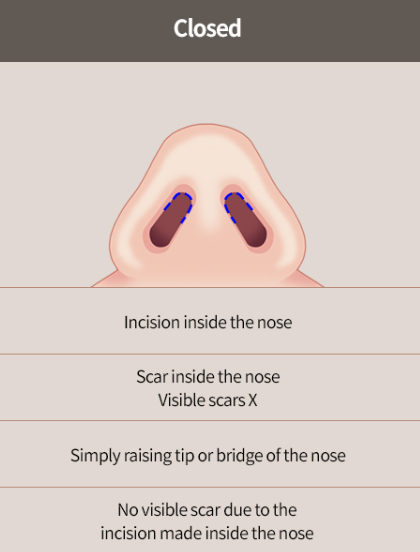
Closed rhinoplasty is performed
through incisions made entirely inside the nose,
with no external incision on the columella.
Because the incision range is minimal,
recovery is generally faster,
and concerns about visible scarring are significantly reduced.
Closed rhinoplasty is suitable for cases such as:
• Nasal bridge implant placement
• Minor nasal tip refinement
• Alar (nostril) adjustments
When major structural changes are unnecessary,
closed rhinoplasty can be an effective option.
However, because internal visibility is limited,
it has constraints in cases requiring
extensive septal reconstruction.
"When Closed Rhinoplasty
Is Most Effective"
Closed rhinoplasty is best suited for
subtle corrections and natural enhancements.
*Limited correction scope
• Satisfactory nasal tip shape, but desire to raise the bridge
• Implant placement only
• No internal structural deformities
*Minimal nasal tip adjustment
• Slightly drooping tip
• Minor refinement without cartilage repositioning
"The Key Is Not Which Method Is Better,
But Which One Is Right for You"
There is no superiority between the two techniques.
To achieve the results you want,
we strongly recommend a thorough consultation
and an accurate diagnosis
based on your unique nasal anatomy and goals.